Best Board Games for 4-Year-Olds: 12 Kids Will Actually Play
From cooperative picks to classic roll-and-move favorites, these are the best board games for 4-year-olds — tested picks that hold attention past round three.
As an Amazon Associate and through other affiliate partners, we earn from qualifying purchases.
The single best board game for a 4-year-old is Count Your Chickens by Peaceable Kingdom — it's fully cooperative (the whole table wins or loses together, which means zero meltdowns), requires nothing but counting to ten, and has earned a stack of toy-of-the-year awards that reflect real family approval. If your child is deep in a Bluey phase, the Candy Land Bluey Edition is the smart runner-up: the same breezy rules preschoolers already know, but with Bluey, Bingo, and the whole Heeler crew standing in for gingerbread characters — and it seats up to six players so nobody sits out.
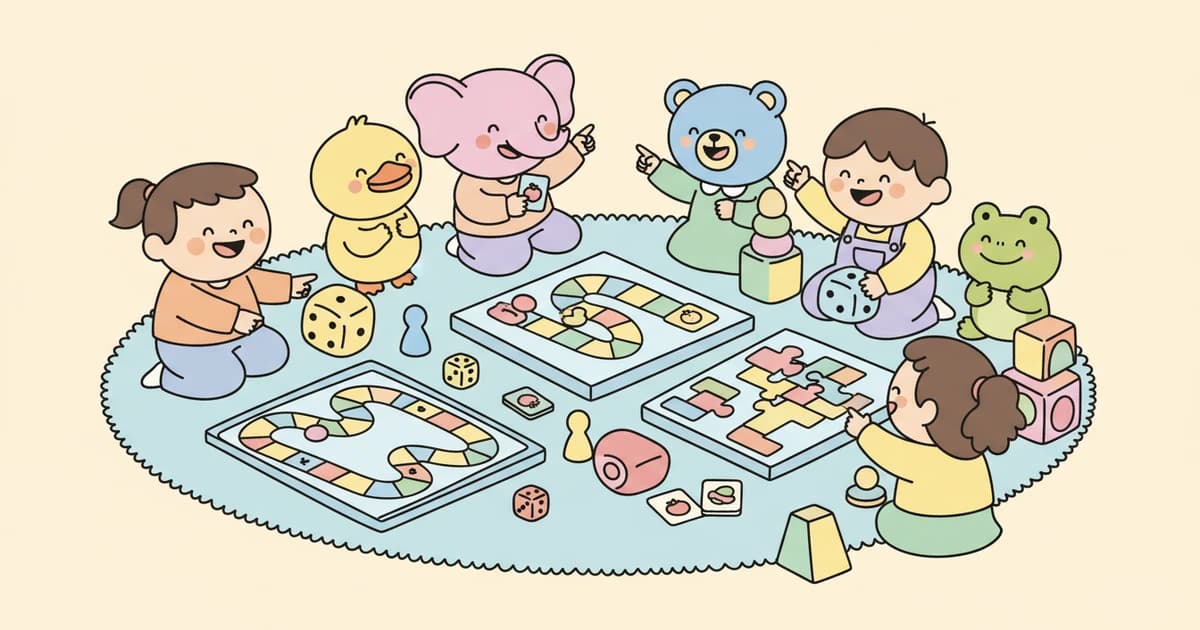
Four-year-olds are in a gifting sweet spot — old enough to follow simple rules and take turns without a meltdown (most of the time), young enough to find rolling a die genuinely thrilling. The challenge is landing on a game that survives more than two playthroughs before it gets pushed to the back of the shelf. This guide cuts through the crowded preschool aisle and picks the best board games for 4-year-olds that families actually return to.
Who should skip this guide: If you're buying for a child under 3, most of these games will run long and require more adult scaffolding than they're worth — simpler shape-sorters or memory-match toys are a better fit. If your kid is already 7 or 8 and breezing through preschool games, scroll to the UNO Junior and Bananagrams entries, or check out a board-games-for-8-year-olds guide instead.
Why Board Games Make Great Gifts for Young Kids
The right board game is one of the few gifts that earns back its cost in hours of actual play. The American Academy of Pediatrics has noted that tabletop games support early numeracy, turn-taking, and emotional regulation — the exact skills a 4-year-old is actively building. A well-chosen game gives a young child a reason to sit at the table with the adults in their life and feel like an equal, which is a genuinely big deal at this age.
The bigger win that most gift lists overlook: cooperative games, where every player works together against the board rather than against each other, have transformed preschool game night. Nobody cries, nobody flips the board, and the adult can steer strategy without sandbagging. Peaceable Kingdom practically invented this format for young kids, and their titles appear twice on this list for good reason. If the child you're buying for is prone to tearful losses, a cooperative pick is the single best move you can make.
Types of Board Games to Consider
The preschool game shelf breaks into four useful categories:
Roll-and-move classics (Candy Land, Chutes and Ladders) rely on pure luck and zero reading. They're the easiest on-ramp for brand-new players, but older siblings may check out fast.
Dexterity and suspense games (Don't Break the Ice, Pop Up Pirate, Hungry Hungry Hippos) swap strategy for physical interaction. Play times run five to ten minutes, so they're perfect fillers before dinner or between longer activities.
Cooperative games (Count Your Chickens, Hoot Owl Hoot) are the category to know. Everyone wins or loses together, which suits 4-year-olds perfectly — the stakes feel real without the social sting of losing.
Early-skill builders (UNO Junior, Bananagrams My First, Let's Go Fishin') sneak in counting, matching, or letter recognition under the guise of play. Good picks when you want to nudge a 4-year-old toward the next developmental step without drilling.
| Gift | Best for | Why it stands out |
|---|---|---|
| Count Your Chickens | First cooperative game for any household | Award-winning, fully cooperative, counting-based mechanics |
| Candy Land Bluey Edition | Bluey fans ages 3–5, groups of up to 6 | Beloved characters on a no-reading format; seats 6 |
| Hoot Owl Hoot | Kids who need a low-frustration intro to teamwork | Cooperative color-matching, peaceful pacing |
| Hungry Hungry Hippos | High-energy kids who love fast, noisy play | Instant action, easy set-up, satisfying marble chaos |
| Pop Up Pirate | Mixed-age groups who love a big surprise moment | Suspense builds every turn; the pop never gets old |
| Let's Go Fishin' | Patient kids building fine-motor skills | Spinning pond adds a gentle physical challenge |
| Don't Break the Ice (Classic) | Wide age-range sibling or cousin groups | Classic tension game every age band enjoys equally |
| Candy Land (Classic) | The very youngest players, ages 3–4 | Pure color-matching — zero reading or counting required |
| Chutes and Ladders | Kids beginning to recognise numbers | Path squares introduce early number recognition naturally |
| UNO Junior | 4-year-olds ready to step up from preschool games | Simplified card game with real decision-making |
| Bananagrams My First | Pre-readers being introduced to letters | Picture tiles bridge matching play to early spelling |
| Don't Break the Ice: Mammoth Edition | Fans of the original wanting a fresh twist | Larger blocks, woolly mammoth theme, extended replayability |
Top Board Game Gift Ideas for 4-Year-Olds
Peaceable Kingdom Count Your Chickens
Top Pick: Count Your Chickens is a cooperative counting game where everyone around the table works together to herd baby chicks back to the coop before the game ends — and it wins here because it's the only pick on this list where a 4-year-old genuinely leads the strategy rather than just moving a piece based on what luck dictates. The cooperative format eliminates the sore-loser problem entirely, and the chicken-herding mechanic builds counting skills so naturally that kids don't notice they're learning. A string of toy-of-the-year awards backs up what parents already know: families keep playing this one long after the novelty should have worn off.
Best for: Any household buying their first cooperative game — especially parents tired of consoling a 4-year-old after a competitive loss.
What buyers love: Reviewers consistently highlight how long this stays in rotation — families report replaying it weekly months after the initial gift.
Worth knowing: The small chick pieces can wander easily; several buyers recommend storing the box out of toddler reach between play sessions to avoid losing pieces.
View on Amazon
Hasbro Gaming Candy Land Bluey Edition
Candy Land rebuilt around the Heeler family — players choose to be Bluey, Bingo, Bandit, Chilli, Muffin, or Socks and race through a colourful path to reach the end. The rules are identical to the classic (draw a card, move to the matching colour), so any adult can explain it in under a minute, and up to six players means the whole family fits at the table without anyone sitting out. It's a smart pick if the child receiving this has been watching Bluey on a loop — the familiar faces make the game feel personal in a way the original candy characters simply can't.
Best for: Bluey-obsessed kids ages 3–5 whose households already quote the show at dinner.
What buyers love: Parents call out the six-player capacity as genuinely useful — it's rare to find a preschool game that seats the whole family without someone waiting on the sideline.
Worth knowing: If the child doesn't know Bluey, the classic Candy Land is a more universally recognisable choice; the character skins are the entire point of this edition.
View on Amazon
Peaceable Kingdom Hoot Owl Hoot
Players work together to fly all the owls back to their nest before sunrise — Hoot Owl Hoot is a cooperative colour-matching game that functions as the natural next step after Count Your Chickens for kids ready for slightly more strategic teamwork. Each turn a player draws a card and moves an owl to the matching colour, and the whole table wins or loses together. The nature theme is gentle and calm, and the pacing makes it one of the quieter picks on this list — ideal for households that want game night to wind down rather than rev up.
Best for: Calm or introspective 4-year-olds who need a low-frustration introduction to cooperative strategy.
What buyers love: The genuine sense of achievement when the owls all make it home — reviewers note that young kids feel real pride at winning, which keeps them asking to play again.
Worth knowing: The game is deliberately winnable to keep young kids engaged, which means adults playing without young children will find the challenge minimal; it's designed squarely for the 3–5 range.
View on Amazon
Hasbro Gaming Hungry Hungry Hippos
Four coloured hippos, a pile of marbles, and the most satisfying clatter in preschool gaming — Hungry Hungry Hippos has been a household fixture for over 50 years because it delivers exactly what it promises: fast, noisy, zero-reading fun. Players mash their hippo's lever to gobble marbles, and whoever collects the most wins. There's no strategy and no reading, which puts the youngest players at the table on a level playing field with the oldest. The updated version here features instant marble relaunch and easier set-up, addressing the main gripe parents had with the original.
Best for: High-energy kids who need a physical release — and any adult happy to hear five minutes of joyful chaos.
What buyers love: How fast the game gets going — no rules explanation needed, just set it up and start slamming levers.
Worth knowing: Marbles scatter and roll under furniture; several buyers suggest playing on a tray or carpet rather than hardwood for much easier clean-up.
View on Amazon
TOMY Pop Up Pirate
Pop Up Pirate builds tension one sword-slot at a time — players take turns pushing coloured swords into the barrel, and whoever hits the hidden trigger sends the pirate flying into the air. The game is pure suspense mechanics, nothing else, which makes it one of the most age-neutral picks on this list: a 3-year-old and a 10-year-old experience the exact same stomach-drop moment when the pirate launches. Games run about five minutes, so it works perfectly as a quick play before a longer activity or as a gift that lives in a travel bag.
Best for: Mixed-age sibling groups or families who want a quick filler game that needs no rulebook.
What buyers love: The launch moment — reviewers say kids who have played dozens of times still shriek when the pirate pops, and younger siblings beg for one more round repeatedly.
Worth knowing: Very young toddlers (under 3) sometimes struggle to push the swords in with enough force; it plays more smoothly from age 4 and up.
View on Amazon
Let's Go Fishin' by Pressman
A spinning pond of fish with opening and closing mouths, a set of small fishing rods, and a deceptively simple challenge: catch as many fish as you can before they slip away. Let's Go Fishin' is one of those rare games that genuinely builds a real skill — hand-eye coordination and patience — while feeling like pure play. The rotating pond keeps the difficulty honest because the fish don't wait for you, and 4-year-olds quickly learn that rushing doesn't help. One to four players can compete or simply take turns fishing at their own pace, making it adaptable for game nights and solo play alike.
Best for: Patient, focused 4-year-olds working on fine-motor skills — also a natural pick if the child has an interest in the outdoors.
What buyers love: How long kids play independently — many reviewers report their child setting up and fishing solo for extended stretches without any adult involvement.
Worth knowing: The small fish pieces and hooks are a swallowing hazard for children still in the mouthing phase; best saved for kids who are genuinely past that stage.
View on Amazon
Hasbro Don't Break the Ice (Classic Version)
Tap out the ice blocks one at a time and try not to be the player who sends Phillip the polar bear plunging through — Don't Break the Ice is a tension-and-dexterity classic that has been a staple of family game nights for decades. The setup is simple: build the ice platform, then take turns tapping blocks loose with the little mallet. The tactile satisfaction of the mallet and the rising tension as the platform thins out make this genuinely exciting for kids and adults alike. Rules take 30 seconds to explain, and the replay value comes from the unpredictability of which block will finally send Phillip down.
Best for: Households with a wide age range — a 4-year-old and a 9-year-old have equal fun because luck drives the outcome as much as skill.
What buyers love: The mallet mechanic — reviewers consistently say tapping out the blocks is satisfying in a way that keeps kids asking for round after round.
Worth knowing: The ice platform takes a couple of minutes to set up, and younger kids sometimes get impatient before play begins; an adult hand speeds up setup considerably.
View on Amazon
Hasbro Gaming Candy Land (Classic)
The game that introduced generations of kids to the idea of taking turns — Candy Land strips board gaming to its absolute basics: draw a colour card, move to that colour, first to the castle wins. No reading, no counting, no decisions. For a 3- or 4-year-old encountering their first board game, that simplicity is the entire point. It sets up in two minutes, plays in about fifteen, and teaches the core social skill of turn-taking in a structured, low-stakes setting. The Amazon-exclusive edition carries the original Kingdom of Sweet Adventures artwork.
Best for: The very youngest players (ages 3–4) experiencing their very first board game — and gift-givers who want a universally recognisable classic.
What buyers love: Its simplicity — parents appreciate being able to play the first round with minimal explanation, which reduces the frustration that can derail a 3-year-old's first game experience.
Worth knowing: Kids aged 5 and up often find it too luck-dependent and lose interest quickly; it's a stepping-stone game designed for the youngest players, not a long-term staple.
View on Amazon
Hasbro Gaming Chutes and Ladders
Spin the spinner, count your spaces, and either climb a ladder toward the top or slide all the way back down a chute — Chutes and Ladders adds one useful step of complexity beyond Candy Land by introducing numbered squares, giving young players their first organic exposure to number recognition and counting. The dramatic reversals (sliding back almost to the start right before the finish) are equally agonising and thrilling for 4-year-olds, which makes the emotional range of the game a useful early-childhood experience in its own right. Two to four players, instant setup, and the spinner keeps turns moving quickly.
Best for: Kids beginning to recognise numbers 1–10 who are ready for a small step up from pure colour-matching games like Candy Land.
What buyers love: The teaching value of number recognition without it feeling like a drill — parents report kids eagerly counting their own spaces from the very first play.
Worth knowing: The random spinner means games can end quickly or drag on, and a child who slides back on the final few squares can get genuinely upset; keeping reactions light and calm from the adult side helps a lot.
View on Amazon
Mattel Games UNO Junior
UNO Junior takes the iconic card game and rebuilds it for kids who aren't ready for the full version — the deck uses animal illustrations instead of numbers, matching works by colour or creature, and the action cards are simplified so no reading is required. The meaningful difference from roll-and-move games is that players hold a hand of cards and make an actual choice each turn, which is the entry point for real strategic thinking. Kids who master UNO Junior often transition to the full UNO naturally, giving this gift a longer shelf life than most pure-luck preschool games.
Best for: A 4-year-old ready to make real decisions in a game, rather than just move based on what a spinner or drawn card dictates.
What buyers love: How grown-up kids feel playing a "real" card game — reviewers note how proud young kids are to play the same UNO their older siblings and parents play.
Worth knowing: Holding a hand of cards is a motor-skill challenge for small hands; some 3-year-olds find it genuinely frustrating, making this a stronger fit for 4-and-up than the stated age minimum suggests.
View on Amazon
Bananagrams My First
A gentler spin on the adult word game — Bananagrams My First replaces letter-only tiles with picture-and-letter tiles so pre-readers can play alongside readers. Players match pictures to starting letters, building a simple word grid that blends image recognition with the very first steps of spelling. It's a multi-award winner that sits neatly between a toy and a game, and it scales with the child: a 4-year-old plays by pictures while a 7-year-old in the same household can play a full spelling version. That range makes it one of the better longevity buys on this list.
Best for: Pre-readers beginning to show curiosity about letters — and households with a mixed age range where one game needs to serve multiple kids.
What buyers love: The dual-mode play — buyers highlight that the game grows with the child so it's still getting used a year or two after other preschool games have been shelved.
Worth knowing: Without a reader in the game to guide the spelling mode, a solo 4-year-old plays the picture-matching version only; the spelling layer needs at least one older player to unlock fully.
View on Amazon
Hasbro Gaming Don't Break the Ice: Mammoth Edition
The Mammoth Edition takes everything that works about the classic Don't Break the Ice and scales it up — larger ice blocks, a woolly mammoth in place of the polar bear, and a fresh prehistoric look that makes it feel like a genuinely different game rather than a reprint. The bigger blocks are physically easier for small hands to tap cleanly, which actually makes this a slightly smoother experience for younger players than the original. If the child already owns classic Don't Break the Ice, this edition offers enough difference to function as a real upgrade rather than a duplicate.
Best for: Fans of the original wanting a fresh twist, or younger kids (ages 3–4) whose hands find the larger blocks easier to manage.
What buyers love: The bigger block size — reviewers say it makes the mallet-tapping more satisfying and slightly more accessible for very small hands compared to the classic version.
Worth knowing: The larger board takes up more table space and more storage room; a few buyers note it's bulkier to put away, which is worth considering if toy storage is already tight.
View on Amazon
Frequently Asked Questions
What makes a board game appropriate for a 4-year-old? Three things: no reading required (or minimal), a playtime under 20 minutes, and rules explainable in under two minutes. A 4-year-old can absolutely follow structured rules and take turns — they just can't sustain attention for a 45-minute game, and reading-dependent mechanics immediately cut them out of the action.
Are cooperative games actually better for young kids than competitive ones? For the 3–5 age range, yes — and the logic is straightforward. When everyone wins or loses together, there's no social sting attached to losing, which means kids are far more willing to play again and far less likely to end the session in tears. It also means a parent can guide strategy without feeling like they're throwing the game. From age 6 or 7, most kids can handle competitive games emotionally; before that, cooperative is the lower-friction choice by a significant margin.
How many players do these games need? Most of the games on this list work well with two players — one adult, one child — which is important because a lot of preschool game nights are exactly that. Count Your Chickens, Candy Land, Chutes and Ladders, and Let's Go Fishin' all play comfortably with just two. The Candy Land Bluey Edition is the standout for larger groups, seating up to six.
What's a reasonable budget for a 4-year-old's birthday game gift? Preschool board games are among the most affordable gifts in the toy category. Every pick on this list represents good value, with the Peaceable Kingdom cooperative titles typically running a touch above the Hasbro classics. None require batteries, expansions, or add-ons — the box is the whole game.
My 4-year-old has a very short attention span. Which game should I pick? Go for one of the dexterity picks — Pop Up Pirate, Hungry Hungry Hippos, or Let's Go Fishin'. They run five to ten minutes, require no sitting-still patience, and the physical interaction keeps younger kids locked in from start to finish. Save the cooperative narrative games (Count Your Chickens, Hoot Owl Hoot) for when they're ready to follow a slightly longer arc.
The Bottom Line
The best board games for 4-year-olds are the ones that get played more than twice — and every game on this list earns that. Count Your Chickens is the top pick because cooperative play is the right format for this age: it removes the sting of losing while keeping the game meaningful, and it builds real counting skills along the way. Pair it with a five-minute dexterity game like Pop Up Pirate for the evenings when a quick filler is all you need, and you've built a starter game library a 4-year-old will actually want to open.